GEO vs SEO : The Complete Strategy Guide for AI Search Visibility
Introduction
AS The best freelance digital marketer in palakkad kerala. The search landscape has fundamentally changed. Traditional SEO isn’t dead, but it’s no longer sufficient on its own. Generative Engine Optimization represents the next evolution of digital visibility.
Success in 2025 and beyond requires a dual-pronged approach: maintaining SEO excellence while simultaneously building Generative Engine Optimization authority. The brands that master this balance will dominate the AI-powered search era.
The opportunity is now. Most companies haven’t yet adapted to this new reality, creating a first-mover advantage for those who act quickly.
Your next step: Start testing your current AI visibility today. Query ChatGPT, Claude, and Perplexity about your core topics. Are you being cited? If not, you now have the complete framework to change that through effective Generative Engine Optimization strategies..

What is GEO (Generative Engine Optimization)?
Generative Engine Optimization (GEO) is the process of optimizing content so it can be easily discovered, cited, and recommended by AI-powered language models and conversational search platforms. Unlike traditional SEO, which focuses on ranking in search engine results, GEO targets how AI systems like ChatGPT with web search, Google’s AI Overviews (SGE), Microsoft Copilot, Perplexity AI, Claude with search capabilities, Gemini (formerly Google Bard), and SearchGPT access, interpret, and present information. The goal of GEO is to make content more visible and trustworthy within AI-generated responses, ensuring that your brand or website is recognized as a reliable source in the emerging era of generative search.
The Role of GEO in Modern Digital Marketing
1. GEO means Generative Engine Optimization
It’s the practice of making your content visible to AI tools like ChatGPT, Google SGE, and Perplexity AI. GEO helps your business appear when people ask questions through AI-powered platforms instead of traditional search engines
2. It’s the next step after SEO
SEO focuses on ranking your website on Google, while GEO focuses on helping AI systems understand and share your content. Together, they make sure your brand shows up both in search results and in AI-generated responses.
3. AI is becoming the new search tool
People are now using AI chatbots to find quick and accurate answers instead of searching manually on Google. GEO ensures your content is visible in these new types of searches, where AI gives direct answers.
4. Helps increase brand visibility
When AI tools mention your brand in their responses, more users discover your business across multiple platforms. This increases your online presence and builds recognition without relying only on SEO rankings.
5. Improves content quality
GEO pushes creators to write factual, simple, and meaningful content that answers real questions. This makes your content valuable for both human readers and AI algorithms looking for trustworthy information.
6. Future-proofs for your business
As AI continues to change how people find information, GEO ensures your content stays relevant in the coming years. Adopting GEO early gives you a strong advantage over competitors who only focus on old SEO methods.
7. Increases organic reach
GEO allows your content to appear in different places — from Google search results to AI-generated answers. This helps you reach a larger audience, attract more visitors, and strengthen your brand reputation.
Why GEO Matters in 2025
In 2025, Generative Engine Optimization (GEO) has become a crucial part of digital marketing and content strategy. As AI-driven platforms like ChatGPT with web search, Google’s AI Overviews (SGE), Microsoft Copilot, Perplexity AI, Claude, and Gemini continue to dominate how people find and consume information, the way businesses appear online is changing rapidly. Traditional SEO is no longer enough — people are increasingly asking AI tools questions instead of typing keywords into search bars. This shift has given rise to the need for GEO, which focuses on optimizing content to be discoverable, cited, and recommended by AI systems.
1. AI is the new search engine
AI chatbots and generative search tools are replacing traditional search engines for many users. Instead of browsing multiple links, people now reallly on a single AI-generated summary or recommendation. GEO ensures your content is visible to these AI engines, helping your brand remain discoverable in AI-generated answers.
2. Trust and Credibility
AI tools prefer to reference authoritative, original, and well-structured content. By using GEO strategies — such as creating high-quality, factual, and well-cited articles — your brand becomes a trusted source that AI systems repeatedly recommend.
3. voice and conventional growth
In 2025, conversational AI and voice assistants are more common than ever. GEO helps your content appear naturally in AI-driven conversations, giving your brand a presence in the next generation of search interfaces beyond text-based results.
4. Competitive Advantage
Most businesses still focus only on traditional SEO. Adopting GEO early positions you ahead of competitors who haven’t yet optimized for AI discovery. This foresight ensures your brand stays relevant as the digital landscape evolves.
AI Is the New Search Engine
The Hybrid Strategy: Combining SEO and GEO
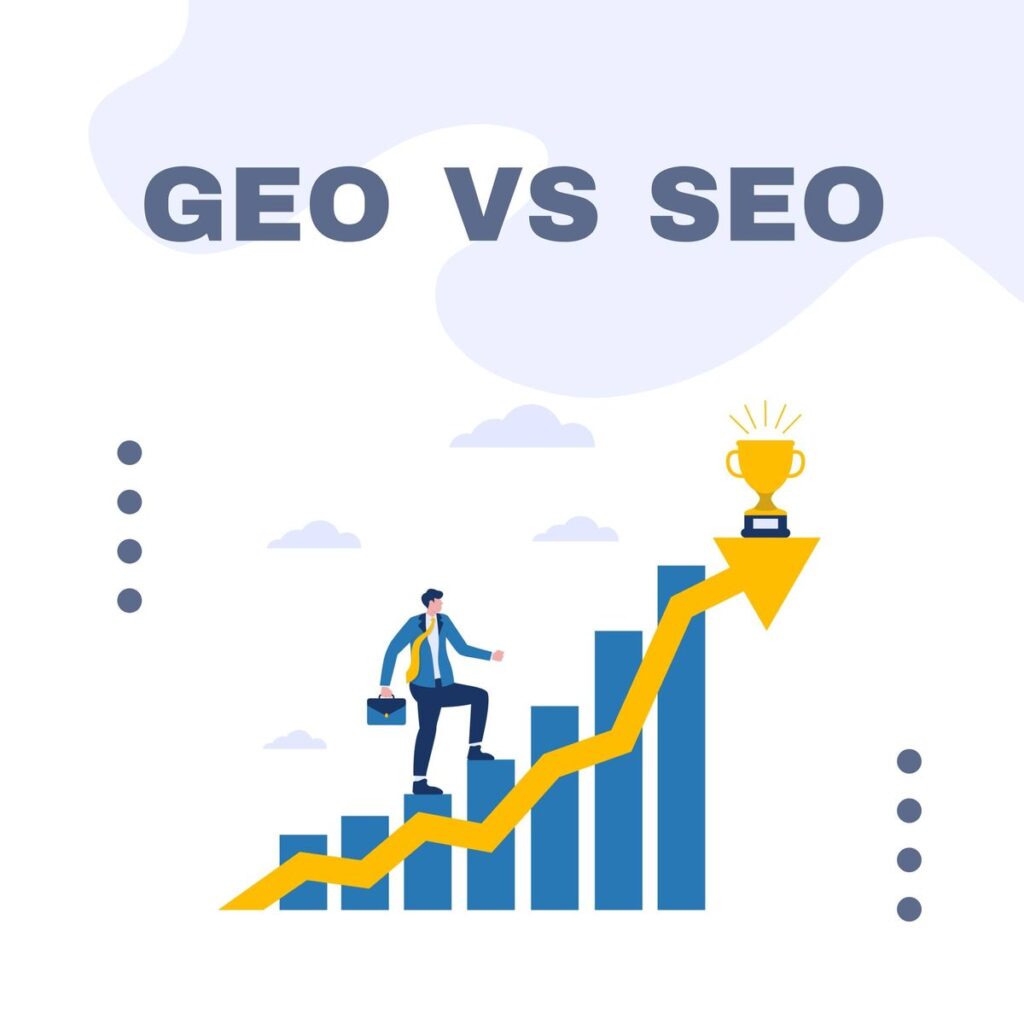
In 2025, the smartest digital marketers are using a hybrid strategy — combining SEO (Search Engine Optimization) and GEO (Generative Engine Optimization) to reach audiences across both traditional and AI-powered search platforms. While SEO helps your content appear on search engines like Google and Bing, GEO ensures your content is discoverable and cited by AI tools such as ChatGPT, Google SGE, Perplexity AI, and Microsoft Copilot.
1. SEO Builds the Foundation
Traditional SEO focuses on improving your website’s visibility in search engines. It includes:
- Using keywords like Generative Engine Optimization that people search for.
- Optimizing titles, meta descriptions, and headings.
- Building backlinks from trusted websites.
- Ensuring fast loading speed and mobile optimization.
2. Generative Engine Optimization Expands Your Reach
GEO on the other hand, focuses on how AI models read, understand, and recommend your content.
To optimize for GEO:- Write clear, factual, and structured content that AI can easily summarize.
- Use authoritative sources and citations to build credibility.
- Answer questions conversationally, since AI prefers natural language.
- Keep your content fresh and updated, as AI tools value recent information
3 . Benefits of the Hybrid Strategy
- Wider online visibility across both search and AI platforms.
- Better brand authority as AI systems start citing your content.
- Increased trust and organic traffic from diverse sources.
- Future-ready content that adapts to new AI search behaviors.
4 . How SEO + Generative Engine Optimization Work Together
By combining both strategies, you cover all discovery channels:
- SEO helps people find your site on traditional search
- GEO ensures your content appears in AI-driven conversations and summaries.
The search landscape has fundamentally changed. Traditional SEO isn’t dead, but it’s no longer sufficient on its own. Generative Engine Optimization represents the next evolution of digital visibility.
Success in 2025 and beyond requires a dual-pronged approach: maintaining SEO excellence while simultaneously building GEO authority. The brands that master this balance will dominate the AI-powered search era.
The opportunity is now. Most companies haven’t yet adapted to this new reality, creating a first-mover advantage for those who act quickly.
Your next step: Start testing your current AI visibility today. Query ChatGPT, Claude, and Perplexity about your core topics. Are you being cited? If not, you now have the complete framework to change that.
The future of search is conversational. The future of marketing is being the source AI trusts.
Conclusion
The search landscape has fundamentally changed. Traditional SEO isn’t dead, but it’s no longer sufficient on its own. Generative Engine Optimization represents the next evolution of digital visibility.
Success in 2025 and beyond requires a dual-pronged approach: maintaining SEO excellence while simultaneously building Generative Engine Optimization authority. The brands that master this balance will dominate the AI-powered search era.
The opportunity is now. Most companies haven’t yet adapted to this new reality, creating a first-mover advantage for those who act quickly.
Your next step: Start testing your current AI visibility today. Query ChatGPT, Claude, and Perplexity about your core topics. Are you being cited? If not, you now have the complete framework to change that.
The future of search is conversational. The future of marketing is being the source AI trusts.